Bright-red blood after a bowel movement is a common early sign of piles, but rectal bleeding is not automatically caused by hemorrhoids. By the end, you will know which symptoms fit internal or external piles, which warning signs need prompt assessment, what an examination involves, and how doctors match treatment to hemorrhoid grade and severity.
Key takeaways
- Bright-red bleeding without pain can be an early sign of internal piles.
- Sharp pain during bowel movements points more strongly toward an anal fissure.
- Seek medical assessment for heavy bleeding, black stools, fever, or severe pain.
- Treatment may progress from stool correction to procedures when piles persist or prolapse.
Recognising the earliest symptoms of internal and external piles
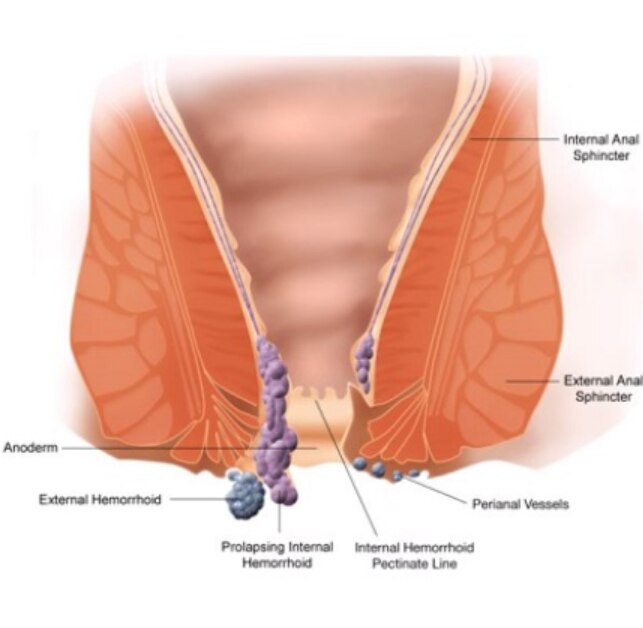
Early internal piles often first show as painless bright-red blood on toilet paper, a blood streak on the outside of stool, or drops in the toilet after a bowel movement. They can also cause mucus, a sense of incomplete emptying, or discomfort after passing stool without producing a visible lump.
Internal and external piles behave differently because they arise in different areas.
| Type | Early symptoms | Why it feels this way |
|---|---|---|
| Internal piles | Bright-red bleeding, mucus, mild discomfort, or tissue that later protrudes | They begin above the dentate line, an area with limited pain sensation, so swollen tissue can bleed without causing pain |
| External piles | Itching and irritation around the anus, swelling, a tender lump, or pain at the anal margin | The outer skin has pain-sensitive nerves, making inflammation or pressure easier to feel |
A sudden firm blue-purple lump with intense pain suggests a thrombosed external pile, where a clot has formed inside the swollen vein. That is different from the softer swelling or itching that can occur early.
Bleeding alone does not prove that piles are the cause. If bleeding recurs, increases, or appears with a persistent change in bowel habit, arrange a medical assessment rather than assuming it is harmless.
How piles differ from fissure, fistula and other causes of bleeding
Bright-red blood on toilet paper or the stool’s surface fits hemorrhoids, especially when bleeding follows straining and stops quickly.
The practical distinction between internal hemorrhoids vs external hemorrhoids is that internal tissue often bleeds without pain, while external tissue causes an anal-margin lump, itching, or tenderness; a thrombosed external hemorrhoid becomes a sudden, firm blue-purple lump.
| Condition | Pattern that points toward it | What needs checking |
|---|---|---|
| Internal hemorrhoid | Painless bright-red bleeding, mucus, or tissue prolapsing during a bowel movement | Persistent bleeding or uncertain source |
| External hemorrhoid | Tender lump or irritation at the anal edge; sudden severe pain suggests thrombosis | Severe pain, rapid swelling, or a lump that does not settle |
| Anal fissure | Anal fissure symptoms include sharp, tearing pain during and after defecation, with a small streak of bright blood | Recurrent fissures, severe pain, or failure to heal |
| Anal fistula | Anal fistula symptoms include a persistent opening, pus or drainage, recurrent swelling, and sometimes fever | Examination for an abscess or a tract |
| Colorectal or intestinal disease | Blood mixed through stool, darker or maroon stool, altered bowel habit, abdominal pain, anaemia, or weight loss | Prompt investigation rather than self-treatment |
These are not the only rectal bleeding causes. A clinician may inspect the area, perform a digital rectal examination, and use anoscopy. Colonoscopy is appropriate when the source remains unclear, bleeding persists, or age, family history, or symptoms make colorectal evaluation due.
Warning signs that make home care the wrong next step
Do not keep treating presumed piles at home when bleeding is heavy, recurrent, or paired with symptoms beyond the anus. Rectal bleeding can also come from a fissure, inflammatory bowel disease, polyps, cancer, or another gastrointestinal problem.
Seek emergency care now if you have:
- Black stool, maroon stool, heavy rectal bleeding, or dizziness or fainting with bleeding.
- Severe or rapidly worsening anal pain, especially with a rapidly enlarging blue-purple lump.
- Fever, pus, repeated vomiting, inability to pass urine, or weakness that accompanies the pain or bleeding.
Arrange prompt medical assessment if bleeding continues beyond a few bowel movements, keeps returning, or occurs without a clear cause.
Do not assume bright-red blood is piles when you also have unexplained weight loss, tiredness or diagnosed anemia, abdominal pain, a new change in bowel frequency or stool shape, or a personal or family history of colorectal cancer or polyps.
A new lump that remains after swelling settles, grows, becomes hard, or bleeds needs examination rather than repeated creams. A clinician can check whether the problem is an internal or external hemorrhoid, thrombosis, fissure, infection, or a condition higher in the bowel.
Hydrocortisone or numbing creams can ease symptoms, but they cannot explain bleeding or correct a prolapse.
What a clinical assessment checks before treatment is chosen
A piles evaluation identifies the bleeding source, checks for complications, and determines whether prolapse is present before treatment is selected. The clinician asks about bleeding colour and frequency, pain, bowel habits, straining, medications, and family history of colorectal cancer or polyps.
Recurrent bleeding, anaemia, weight loss, abdominal symptoms, or altered bowel habit requires a broader assessment.
- Inspection looks for an external hemorrhoid, a thrombosed lump, skin irritation, an anal fissure, a fistula opening, prolapse, pus, or active bleeding.
- A digital rectal examination uses a gloved, lubricated finger to check tenderness, a mass, narrowing, blood, and the condition of the anal canal and rectum.
- Anoscopy uses a short lighted tube to view the anal canal and internal hemorrhoids directly, including their size, bleeding, and prolapse.
- The clinician decides whether further testing is needed. Colonoscopy is not required for every typical piles presentation, but it becomes appropriate when the source remains uncertain, bleeding persists, or age- and risk-based colorectal screening is due.
The Goligher classification records how far internal piles prolapse: grade I bleeds without prolapsing; grade II protrudes during straining but returns alone; grade III needs manual reduction; grade IV remains outside and cannot be pushed back. This finding helps distinguish stool and symptom measures or office treatment from a surgical opinion.
A piles examination cannot safely explain away unexplained rectal bleeding.
From stool correction to procedures: when medical treatment becomes necessary
Start uncomplicated symptoms by correcting stool mechanics: aim for fiber 20 to 35 grams per day, drink adequate fluids, avoid straining, and leave the toilet instead of sitting there. A fiber supplement helps when diet alone falls short; it can reduce bleeding and persistent symptoms but will not remove bulky prolapse.
| Condition | Usual treatment | When to discuss a procedure |
|---|---|---|
| Uncomplicated symptoms | Fiber, fluids, stool-softening measures, and short-term symptom relief | Discuss review if bleeding or discomfort persists despite consistent stool correction |
| Thrombosed external hemorrhoid | Analgesia, stool-softening measures, and time | Severe, recent pain can justify surgical excision; this is different from rubber-band ligation |
| Grade I internal hemorrhoid | Stool correction; rubber-band ligation for persistent symptomatic bleeding | Discuss ligation when symptoms continue |
| Grade II internal hemorrhoid | Stool correction or rubber-band ligation | Discuss ligation when prolapse repeatedly returns after straining |
| Grade III internal hemorrhoid | Rubber-band ligation in selected cases | Discuss a surgeon’s assessment when manual reduction is needed or office treatment fails |
| Grade IV internal hemorrhoid | Surgical assessment, often including excisional hemorrhoidectomy | Persistent, non-reducible prolapse generally needs operative planning |
Rubber-band ligation targets internal tissue above the dentate line; placing a band on external or pain-sensitive tissue can cause severe pain. Excisional hemorrhoidectomy suits large external disease, combined internal-and-external disease, or bulky advanced prolapse, but recovery is more demanding.
Dr. Suradkar Laparoscopy Centre 08048032179 can help distinguish a thrombosed external hemorrhoid from prolapsing internal disease and match the examination findings to an office procedure or operation.
Related service
Piles Surgery Dr. Shekhar Suradkar offers advanced and minimally invasive piles surgery at Highway Hospital, ensuring safe, painless, and effective treatment. View service → |
Frequently asked questions
What are the earliest symptoms of internal and external piles?
Internal piles often cause painless bright-red blood on toilet paper, stool, or in the toilet. External piles may cause a lump, itching, swelling, tenderness, or sudden severe pain if a clot forms.
How can you tell piles from a fissure or fistula?
A fissure usually causes sharp, cutting pain during and after passing stool with a small amount of bright-red blood. A fistula often causes recurring swelling, pus-like discharge, skin irritation, or an opening near the anus. Piles more commonly cause painless bleeding, itching, swelling, or tissue prolapse.
When is home care the wrong next step for suspected piles?
Arrange prompt medical assessment for heavy or repeated bleeding, black or maroon stools, dizziness, fainting, fever, pus, severe pain, a persistent lump, or symptoms that do not improve with stool-softening measures.
What happens during a clinical assessment for piles?
A clinician reviews bleeding, bowel habits, pain, prolapse, medications, and medical history, then examines the anus and rectum. The assessment can include a digital rectal examination and anoscopy before treatment is selected.
When do piles need medical treatment or a procedure?
Start with stool correction when constipation and straining drive symptoms. Medical treatment becomes necessary when bleeding persists, piles prolapse, symptoms recur, or conservative care fails; options can include prescription treatment, rubber-band ligation, injection treatment, or surgery depending on severity.